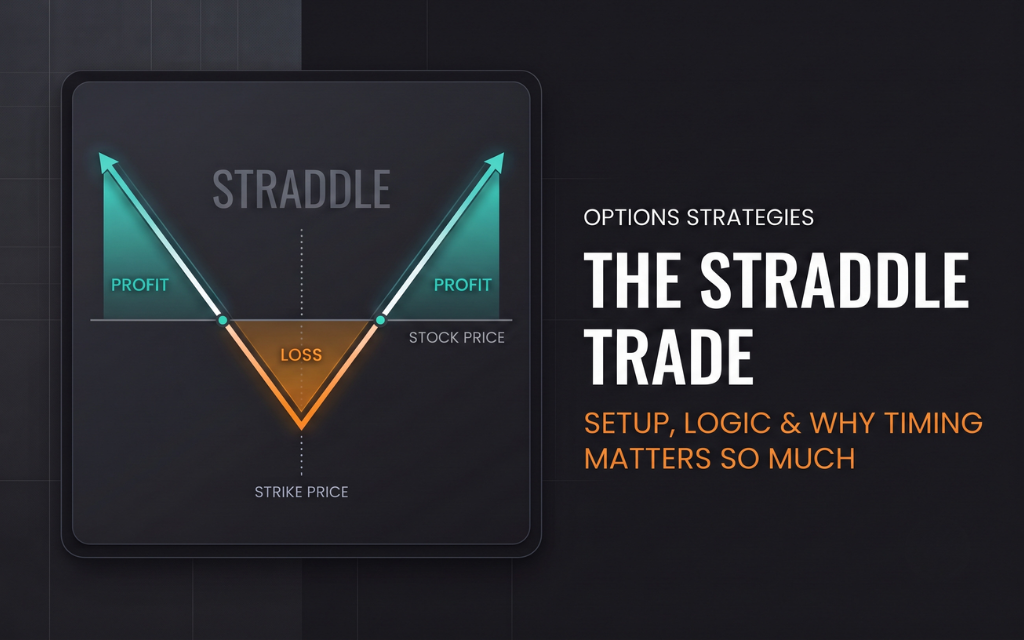
A straddle is one of the most straightforward ways to trade expected volatility in options. The setup involves buying a call and a put with the same strike price and expiration date. Instead of choosing whether the underlying will move higher or lower, the trader is positioning for a significant move in either direction.
That sounds simple. The difficult part is understanding how much movement is already priced into the options.
A good online options trading program teaches this distinction early because predicting a large move is only one part of the trade. Timing, implied volatility and option pricing can determine whether that prediction actually translates into a profitable position.
What Is a Long Straddle?
A long straddle typically involves buying an at-the-money call and an at-the-money put with the same expiration.
If the underlying moves sharply higher, the call can gain value. If it moves sharply lower, the put can gain value.
The challenge is that the trader pays a premium for both options. Therefore, the underlying generally needs to move far enough to overcome the combined cost of those options before expiration.
This is why straddles are not simply a bet on movement. They are a bet on movement that is larger, faster, or otherwise more favorable than what the market has already priced in.
Why Implied Volatility Changes the Equation
Implied volatility is one of the most important variables when evaluating a straddle.
Before major events such as earnings announcements or economic releases, uncertainty can increase option premiums. Traders may therefore pay significantly more for calls and puts before the event.
Then the event happens and implied volatility can fall sharply.
This is known as volatility crush.
The underlying may make a sizable move, yet the straddle can still disappoint if the move was smaller than the market expected or if the decline in implied volatility removes substantial option premium.
This is an important concept in options trading education because traders need to understand not only where the underlying might move, but also what the options market is already expecting.
Timing and Theta Matter
Long straddles have another challenge: time.
Every day that passes brings the position closer to expiration, and Theta gradually erodes the time value of both options. If the expected movement does not happen quickly enough, the trade can lose value even if the trader’s directional view eventually proves correct.
This is where Gamma becomes interesting.
As expiration approaches, a long straddle can become increasingly sensitive to sharp price movements. A strong move in the underlying can cause the profitable option’s Delta to change rapidly, potentially accelerating gains.
But that sensitivity works alongside substantial time decay.
The trader therefore needs more than a correct market thesis. The timing of the move matters.
Why Context Matters More Than the Setup
A straddle should not be evaluated in isolation.
Traders need to consider:
- current implied volatility
- expected price movement
- time to expiration
- upcoming catalysts
- historical volatility
- and the cost of the position
This is where options trading indicators and other analytical tools can help organise information around volatility and price behaviour. However, the tools should support analysis rather than replace it.
Similarly, option traders researching the best technical analysis for options should remember that technical analysis alone cannot determine whether a straddle is attractively priced. The options market’s implied expectations also matter.
What About Short Straddles?
A short straddle reverses the strategy. Instead of buying both options, the trader sells a call and a put at the same strike and expiration.
The trader benefits if the underlying remains relatively stable and the options lose value through time decay or declining volatility.
However, the risk is substantially different. A short straddle can face very large losses if the underlying makes a significant move, particularly on the upside because the short call has theoretically unlimited risk.
This makes position sizing, risk controls and volatility analysis especially important.
FAQs
Is a straddle bullish or bearish?
Neither by itself. A long straddle is generally designed to benefit from a sufficiently large move in either direction, while a short straddle generally benefits from limited movement.
Can you lose money if the stock makes a big move?
Yes. A long straddle can still lose money if the move is not large enough to overcome the premiums paid, or if other factors such as implied volatility and time decay work against the position.
When are straddles commonly considered?
Traders often examine them around events expected to create significant movement, such as earnings or major economic announcements. However, the cost of the options and the movement already priced into them remain critical.
Final Thoughts
The straddle looks simple because its structure is simple. Its analysis is not.
A trader needs to consider movement, implied volatility, pricing and timing together. Tools, educational resources and even AI based trading tools can help organise that analysis, but they do not remove the need to understand the underlying mechanics.
And for traders exploring swing trading stock recommendations, the broader lesson is similar: a trade idea is only one part of the equation. Market context, timing and risk management can matter just as much as the direction of the forecast.