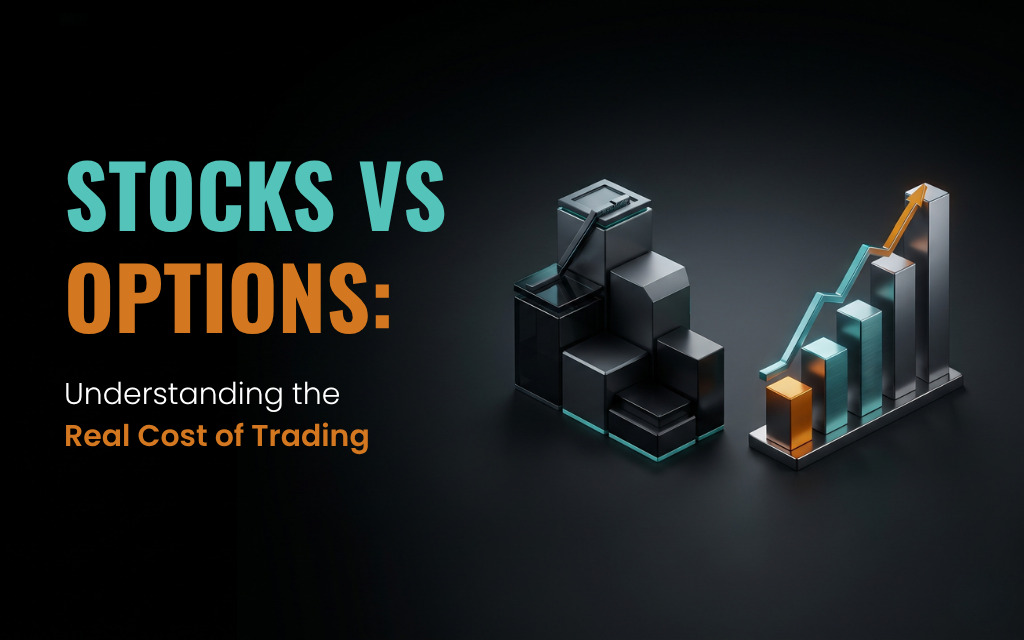
At first glance, options can seem like a cheaper way to access the stock market. Buying 100 shares of a company may require significant capital, while an options contract can cost a fraction of that amount. But a lower upfront payment doesn’t automatically mean a lower trading cost. When comparing stocks vs options, traders also need to consider time decay, implied volatility, execution costs, leverage, and risk management. Understanding these differences can help you make more informed decisions about which instrument suits your trading objectives.
Stocks and Options Have Different Cost Structures
When you buy shares of a company, you own a portion of that business. There is no expiration date, and the passage of time does not directly erode your ownership in the way it can reduce an option’s value.
Options work differently. Their prices are influenced by several factors, including the underlying stock price, time remaining until expiration, implied volatility, and the option’s strike price. This makes their cost structure more complex than the initial premium suggests.
For example, an options contract may provide exposure to a larger position with less upfront capital, but it also introduces risks that stock ownership doesn’t have in the same form. Expiration, changing volatility, and the possibility of losing the entire premium on a purchased option all matter.
For beginners, understanding this distinction is an important step before exploring more advanced strategies through an Online Options Trading Program or a structured options education course.
Time Decay and Implied Volatility Can Change the Outcome
Two factors that can significantly affect an options position are time decay and implied volatility.
Time decay, commonly measured by Theta, reflects how an option’s time value changes as expiration approaches. All else being equal, a purchased option generally loses time value as time passes. A stock, by contrast, does not have an expiration date. This means a sideways market can affect an option buyer differently from a shareholder waiting for a longer-term move.
Implied volatility also influences an option’s price. When traders expect larger price swings, options premiums may rise. Around earnings announcements, for instance, implied volatility can be elevated. Even if a stock moves in the anticipated direction after the announcement, a decline in implied volatility can offset some or all of the gain on a long options position.
This is why correctly predicting direction doesn’t always lead to a profitable options trade. Traders need to consider timing, volatility, and the price paid for the contract—not just where they expect the stock to move.
Leverage, Execution Costs, and Trading Complexity
Options offer leverage: a relatively small premium can provide exposure to a much larger notional position. This can create opportunities, but it can also magnify the consequences of poor timing or an incorrect market view. A low-priced option isn’t necessarily a good-value trade; its probability characteristics, time remaining, volatility, and potential payoff all matter.
Execution costs deserve attention, too. Some options contracts have wide bid-ask spreads, particularly at less liquid strikes or in lower-volume markets. Entering or exiting such positions can create additional friction. Repeated slippage may affect results over time, even when a trader’s market analysis is reasonable.
Options also involve structural considerations such as expiration, assignment, early exercise, and settlement. These mechanics can make position management more demanding than buying and holding shares.
A stock alert service or a trading alert platform may help traders monitor market opportunities, but alerts alone cannot account for every trader’s risk tolerance, execution price, or financial circumstances. Understanding the instrument remains essential before acting on a signal.
How OptionTiger Fits Into Your Trading Education
OptionTiger provides educational resources for traders who want to understand options concepts, strategy structures, and market analysis. Its curriculum progresses from foundational topics to spreads and advanced strategies, while its proprietary indicators and analytical tools support the study of market conditions.
For traders comparing stocks and options, the priority should be understanding how the instrument behaves before deciding whether a particular setup fits their objectives. A structured learning resource, such as the Options Mastery Curriculum, can help learners explore specialised strategies and trade-management concepts. Tools and education can support the learning process, but they cannot guarantee trading outcomes.
Frequently Asked Questions
Are options cheaper than stocks?
Options often require less upfront capital than buying an equivalent number of shares. However, they introduce expiration, time decay, volatility exposure, and other risks. A lower initial cost does not necessarily mean a lower overall trading cost.
Can an options trade lose money even if the stock moves in the right direction?
Yes. An option’s price depends on more than the stock’s direction. Time decay, changes in implied volatility, and the price paid for the contract can all affect the outcome.
Are stocks or options better for beginners?
Neither instrument is automatically better for everyone. Stocks have a more straightforward ownership structure, while options require an understanding of expiration, volatility, and strategy-specific risks. The right choice depends on your knowledge, objectives, and risk tolerance.
Final Thoughts
The real cost of trading goes beyond the amount needed to enter a position. Stocks and options have different risk structures, time considerations, and execution challenges. Before choosing an instrument, consider how it behaves, what could affect its price, and how much you could lose. Building that understanding is a more useful starting point than choosing a trade simply because its entry price looks affordable.
Explore OptionTiger’s educational resources to learn more about options strategies, market analysis, and risk management.