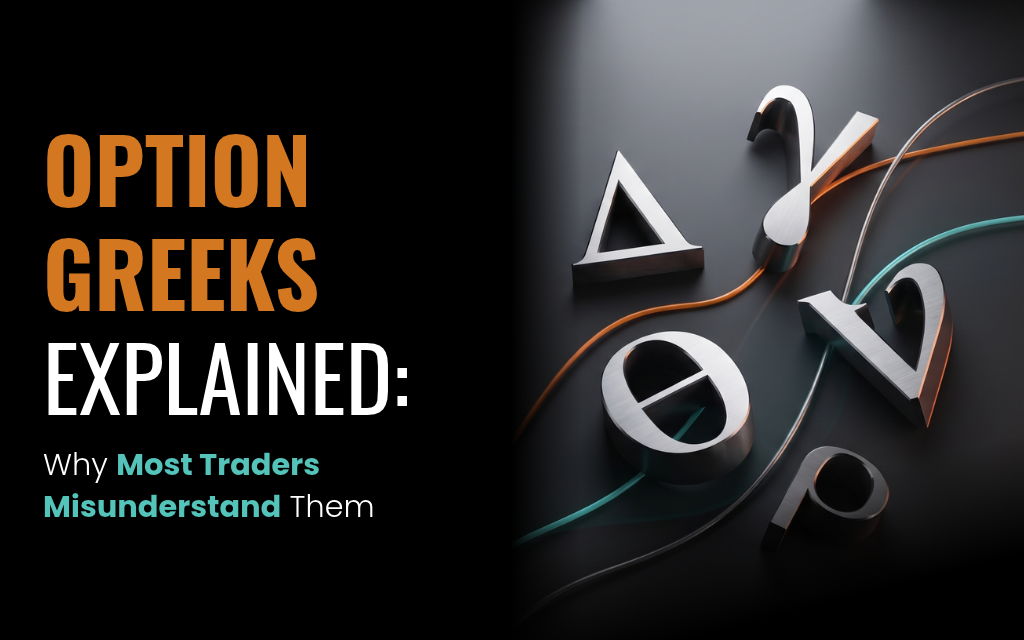
The Option Greeks are among the most important concepts in options trading, yet many traders learn them as isolated mathematical definitions. They memorise that Delta measures directional sensitivity, Theta measures time decay and Vega measures volatility exposure, but struggle to apply these concepts to actual positions. The real value of the Greeks lies in understanding how they interact as market conditions change. They help traders evaluate what can influence an option’s price beyond simply whether the underlying stock moves up or down.
Why the Option Greeks Matter
A common mistake among newer traders is focusing almost entirely on market direction. They ask whether a stock will rise or fall, assuming that getting the direction right should lead to a profitable options trade.
But an option’s price responds to several factors simultaneously, including the underlying asset’s price, time remaining until expiration, implied volatility and interest rates. The Greeks help quantify how sensitive an option is to these variables.
This is why quality Options Trading Education should go beyond definitions and explain how these measurements affect real positions. A trader can correctly anticipate a stock’s direction and still experience an unexpected outcome because of time decay or changing volatility. Understanding the Greeks helps make those exposures visible before entering a trade.
Delta, Gamma, Theta and Vega: Understanding the Four Main Greeks
Each Greek measures a different aspect of options risk.
Delta estimates how much an option’s premium may change for a $1 move in the underlying asset, all else being equal. A call with a Delta of 0.50 may gain approximately $0.50 if the underlying rises by $1. Delta also changes as the underlying price and other pricing factors change. Although traders sometimes use it as a rough probability reference, it is not a guaranteed probability of an option expiring in the money.
Gamma measures how quickly Delta changes when the underlying price moves. Higher Gamma means Delta can change more rapidly, making an option’s directional sensitivity less stable. This is particularly relevant near expiration and around the strike price.
Theta estimates the impact of time passing on an option’s value, assuming other factors remain unchanged. Long options generally have negative Theta, meaning time decay works against the buyer. The effect can become more pronounced as expiration approaches, particularly for at-the-money options.
Vega measures an option’s sensitivity to changes in implied volatility. Rising implied volatility generally benefits long options, while falling implied volatility can reduce their premiums. This explains why a trader can correctly anticipate a price move but still see an option lose value after an event-driven volatility decline.
The Greeks Work Together, Not Independently
The biggest misunderstanding is treating each Greek as a separate measurement. In reality, they interact throughout the life of an options position.
For example, a long option may benefit from a favourable price movement through Delta, while Gamma changes how much directional exposure the position carries. At the same time, Theta continues to reduce its time value, and a decline in implied volatility may put additional pressure on the premium.
This interaction becomes particularly important for advanced strategies and multi-leg positions. Option buyers and sellers can have very different exposure profiles depending on the structure, strike prices and expiration selected.
Traders using Stock Market Indicators or a Stock Scanner for TradingView can use technical tools to identify price trends, momentum and potential market activity. However, those tools do not replace an understanding of options Greeks. A chart may indicate a possible move, but the Greeks help explain how a particular contract could respond to it.
How Option Tiger Supports Options Education
Option Tiger offers structured learning resources, proprietary indicators and options education designed to help traders understand market behaviour and strategy selection. Its educational approach covers foundational concepts as well as more advanced options strategies and risk management.
Whether someone is exploring an Online Options Trading Course or looking for Stock Market Mentorship, understanding the Greeks is an important part of building a stronger trading foundation. Indicators can support market analysis, but learning how Delta, Gamma, Theta and Vega influence a position helps traders evaluate the risks behind the trade itself.
Frequently Asked Questions
Which Option Greek is the most important?
There is no single most important Greek. Delta, Gamma, Theta and Vega measure different exposures, and their importance depends on the strategy, expiration and market conditions.
Can the Greeks predict whether an options trade will be profitable?
No. The Greeks measure sensitivity to different pricing factors; they do not predict market direction or guarantee an outcome. They are best used as tools for understanding and managing risk.
Why does Gamma matter near expiration?
Gamma can become particularly high for at-the-money options approaching expiration. This means even a relatively small move in the underlying asset can cause a significant change in Delta and the position’s directional exposure.
Final Thoughts
The Option Greeks are more than formulas to memorise. They provide a framework for understanding how options respond to price movements, time decay and volatility changes. Traders who learn to interpret these measurements together can develop a clearer picture of their positions and the risks involved. In options trading, knowing the direction is only part of the equation. Understanding exposure matters just as much.
Explore OptionTiger’s educational resources to build a stronger understanding of options pricing, strategy selection and risk management.